

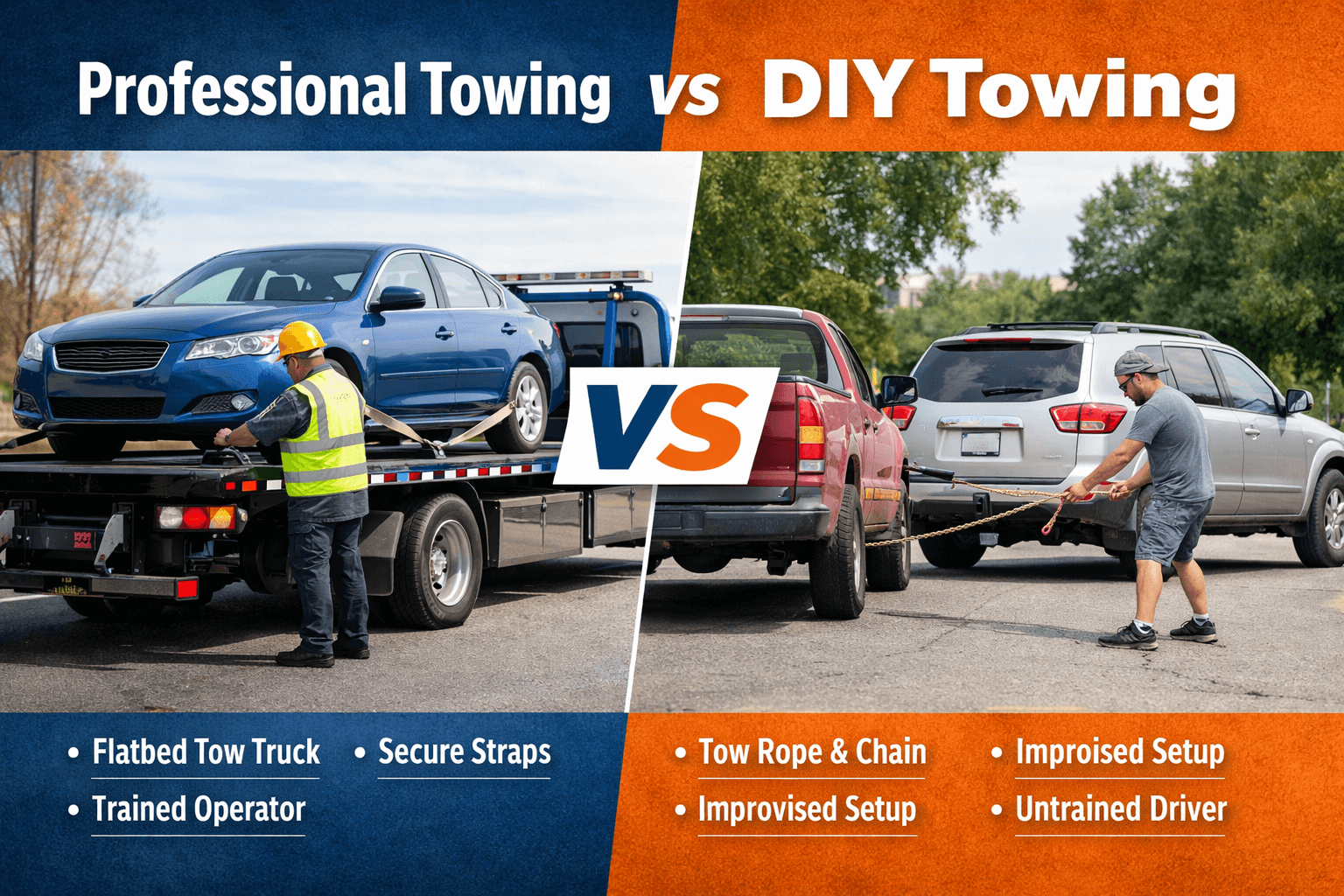
When your car breaks down or gets damaged in a collision, the question of how to move it might feel like a minor detail. It is not. The decision between professional towing and doing it yourself has real consequences for your vehicle, your safety, and everyone else on the road around you.
Both options move a disabled vehicle from one place to another. But how that movement happens, and what risks come with it, are very different stories. This guide breaks down those differences so you can make an informed call when it matters most.
What Professional Towing Involves
Professional towing is not just a truck showing up and hooking onto your bumper. It is a structured process built around keeping your vehicle safe during transport and keeping the road safe for everyone nearby.
A trained operator assesses the situation before anything moves. They look at your vehicle’s weight, drivetrain configuration, visible damage, wheel condition, and where the car is located. A vehicle disabled on a narrow Brooklyn street requires a different setup than one sitting safely in a parking lot. A car with collision damage needs different handling than one with a dead battery.
That evaluation process is what separates professional towing from improvised solutions. The method gets matched to the vehicle and the situation, not the other way around. If you need help after a breakdown or accident, 24/7 towing in Brooklyn is available any time to assess your situation and send the right equipment.
What DIY Towing Usually Looks Like
DIY towing usually involves one vehicle pulling another using a tow strap, rope, chain, or rented dolly. It may be attempted by a friend, family member, or the vehicle owner, often with the goal of saving time or money. In some cases, drivers attempt DIY towing simply to move a vehicle off the road quickly.
While DIY towing can sometimes be done carefully, it often lacks the planning and safeguards used in professional towing. Many DIY setups do not account for weight ratings, secure attachment points, or how the disabled vehicle will respond while being pulled. Steering may be limited, brake assist may be lost, and the towed vehicle may not track evenly behind the towing vehicle.
DIY towing also relies heavily on assumptions. Drivers may assume the vehicle will roll freely, stop smoothly, or follow predictably, but those assumptions do not always hold true, especially when mechanical issues or collision damage are involved.
Safety Differences Between Professional and DIY Towing
Control and vehicle stability
One of the most important differences between professional towing vs DIY towing is how much control the towing setup provides. Professional towing equipment is designed to stabilize the vehicle being transported. Flatbeds eliminate rolling movement entirely, while wheel lift systems maintain alignment and reduce sway.
DIY towing often allows more movement between the towing and towed vehicles. Flexible straps or chains can stretch or shift under load, causing jerking motions when braking or turning. These movements increase the risk of fishtailing, especially at low speeds where drivers may not expect instability.
Roadside visibility and hazard management
Towing often takes place in less than ideal conditions, including busy streets, limited shoulder space, or poor visibility. The National Highway Traffic Safety Administration highlights the importance of visibility and move over practices to reduce the risk of secondary crashes near disabled vehicles (NHTSA, n.d.).
Professional towing setups typically include warning lights, reflective equipment, and positioning strategies that make the scene more visible to other drivers. DIY towing rarely provides the same level of visibility or traffic awareness, which can increase risk even during short tows.
Equipment and Load Capacity Differences
Professional towing uses equipment that is designed, tested, and rated for vehicle transport. Tow trucks are built to handle specific weight ranges, and operators select equipment based on the vehicle’s size and condition. Tie downs, chains, and winches are chosen to secure the vehicle without stressing weak points.
DIY towing often depends on what is available at the moment. Tow straps, ropes, or chains may not be rated for the vehicle’s weight. Attachment points may not be designed for towing forces. When equipment fails, it can happen suddenly, creating a dangerous situation for both vehicles and surrounding traffic.
Load capacity is not just a technical detail. It directly affects safety and vehicle protection during towing.
Vehicle Protection and Drivetrain Risk
Not every vehicle can be towed the same way. Drivetrain configuration determines which towing method is safe for your specific car. Some vehicles should never have wheels rolling on the ground during transport. Others can tolerate it under specific conditions.
Professional towing accounts for this. Flatbed towing is the standard choice when drivetrain protection matters or when vehicle condition is unclear after a collision. DIY towing frequently drags wheels that should not be rolling, which causes internal damage that does not always show up immediately.
That damage tends to surface later as transmission problems, differential noise, or uneven wear. By then, it is hard to trace back to the tow. If your vehicle has visible damage after an accident, auto body repair in Brooklyn should follow a proper flatbed tow, not an improvised one that may have added new problems along the way.
Legal and Liability Considerations
DIY towing can create legal and liability concerns if something goes wrong. Improvised towing setups may not meet roadway safety requirements related to lighting, braking distance, or secure attachment. If the towed vehicle detaches, blocks traffic, or causes a collision, responsibility may fall on the driver who attempted the tow.
Professional towing is generally structured to operate within accepted safety practices and expectations. While laws vary by location, using appropriate equipment and procedures reduces the likelihood of violations or disputes if an incident occurs.
Professional Towing Methods DIY Towing Cannot Replicate
Flatbed towing
Flatbed towing supports the entire vehicle with all wheels off the ground. This method is commonly used after accidents or when vehicle condition is unknown. It reduces stress on the drivetrain and minimizes contact with the road surface.
DIY towing cannot replicate flatbed transport without specialized trucks and loading systems.
Recovery and winch services
Professional towing often involves recovery, not just transport. Vehicles may need to be repositioned from tight spaces, uneven surfaces, or unsafe angles. Controlled winching allows the vehicle to be moved gradually and safely.
DIY towing attempts in these situations can worsen damage or cause sudden movement if force is applied incorrectly.
Hidden Risks of DIY Towing
The damage from a bad tow does not always show up on the day of the tow. Alignment problems, suspension stress, and drivetrain damage can develop quietly and only become noticeable once you start driving again.
There is also an insurance complication worth knowing about. After a collision, the timeline of when and how damage occurred matters. If improvised towing adds new damage to a vehicle that was already in an accident, it can blur that timeline and create problems when you are filing an insurance claim for collision damage. Documentation becomes harder to defend when transport damage and collision damage are mixed together.
When DIY Towing Might Be Reasonable
DIY towing carries less risk in very specific, controlled circumstances:
- Moving a vehicle a very short distance at low speed
- In a private, off-road environment with no traffic
- Using properly rated equipment with confirmed attachment points
- When the vehicle’s steering and drivetrain behavior are fully understood
Even then, conditions can change. Traffic, weather, or equipment failure can turn a low-risk situation dangerous quickly. When any of those factors are uncertain, professional towing is the safer call.
Frequently Asked Questions
Professional towing is generally safer because it relies on purpose built equipment and established procedures designed to stabilize vehicles during transport. DIY towing can be done carefully, but it often lacks the safeguards needed when vehicle condition or road conditions are unpredictable.
Some vehicles should not have their wheels rolling during towing due to drivetrain design or damage. Flatbed towing keeps all wheels off the ground, reducing the risk of internal mechanical stress.
Providing details such as the vehicle’s make, model, condition, and exact location helps ensure the correct towing equipment is used and reduces the need for unsafe adjustments.
Safety should come first. If possible, move to a safer location, activate hazard lights, and seek assistance. NHTSA guidance highlights the importance of visibility and caution near disabled vehicles (NHTSA, n.d.).
You can find towing services in Brooklyn NY through online listings that show service areas, operating hours, and customer feedback. Reviewing a local provider’s Google Business Profile can help confirm basic service information.
Professional towing vs DIY towing differs most in planning, equipment, and risk management. Professional towing methods are designed to protect vehicles, reduce roadway hazards, and adapt to real world conditions. DIY towing may appear simple, but it can introduce complications when vehicle limitations or environmental factors are not fully understood.
Understanding these differences allows drivers to make more informed decisions during breakdowns or after accidents. When uncertainty exists, choosing a towing method designed for the situation can help prevent avoidable damage and safety issues.