

Table of Contents
- 1. Why Hail Damage Differs From Other Collision Damage
- 2. The Types of Damage Hailstones Leave Behind
- 3. How an Auto Body Shop Hail Damage Inspection Works
- 4. Paintless Dent Repair Versus Traditional Panel Repair
- 5. The Dent Repair Process From Start to Finish
- 6. Paint, Primer, and Color Matching on Hail-Damaged Panels
- 7. Windshield Damage and Sensor Recalibration After Hail
- 8. Insurance Claims, Deductibles, and Supplements
- 9. Frequently Asked Questions
- 10. Weighing the Repair Decision
When most drivers see hail dents, they assume the fix is a simple matter of popping a few marks out of the metal. Sometimes that is true. But auto body shop hail damage repair covers more than the dents. It also includes paint condition, glass, trim, and nearby sensors.
A single storm can strike a vehicle hundreds of times. Each impact can affect metal, paint, and glass differently. This guide explains how hail repairs are inspected, which methods are used, and what to confirm before approving any work.
1. Why Hail Damage Differs From Other Collision Damage
Most collision damage comes from one concentrated impact. Hail works the opposite way. The force is spread across the whole vehicle in dozens or hundreds of small strikes. The pattern depends on hailstone size, wind, and which way the vehicle was facing.
Several things set hail apart from a typical crash:
- Many small impacts replace one large one
- Damage collects on horizontal panels such as the roof, hood, and trunk
- Paint can be stressed well beyond the visible edge of a dent
- Glass, trim, and mirrors are often hit in the same storm
Because the damage is scattered, auto body shop hail damage is usually evaluated panel by panel. The dent count and dent size on each surface drive the repair method, the labor time, and the final estimate.
Hailstone size matters a great deal. Small hail may leave shallow marks that the paint can flex around. Larger stones can crease metal, crack paint, and break glass in one pass.
2. The Types of Damage Hailstones Leave Behind
Hail damage is easy to underestimate from a quick look in the driveway. A careful inspection checks every outside surface for the following:
- Panel dents: Round, shallow to deep marks on the hood, roof, trunk lid, and upper door areas
- Paint cracking: Fine cracks, chips, or flaking at the center or rim of an impact
- Glass damage: Chips, star cracks, or full fractures in the windshield, rear glass, and side windows
- Trim and moldings: Dented or displaced strips along the roofline, windows, and lower panels
- Mirrors and lights: Cracked housings, lenses, and mirror glass
- Sensors and antennas: Dented or misaligned parts that support parking, camera, or radio systems
Repairs that reach several of these areas fall under body work and car repair. Dent removal, panel work, and refinishing usually need to be coordinated.
3. How an Auto Body Shop Hail Damage Inspection Works
A hail inspection takes longer than an ordinary walkaround. Shallow dents hide in flat daylight and only show up under controlled lighting.
Technicians often use:
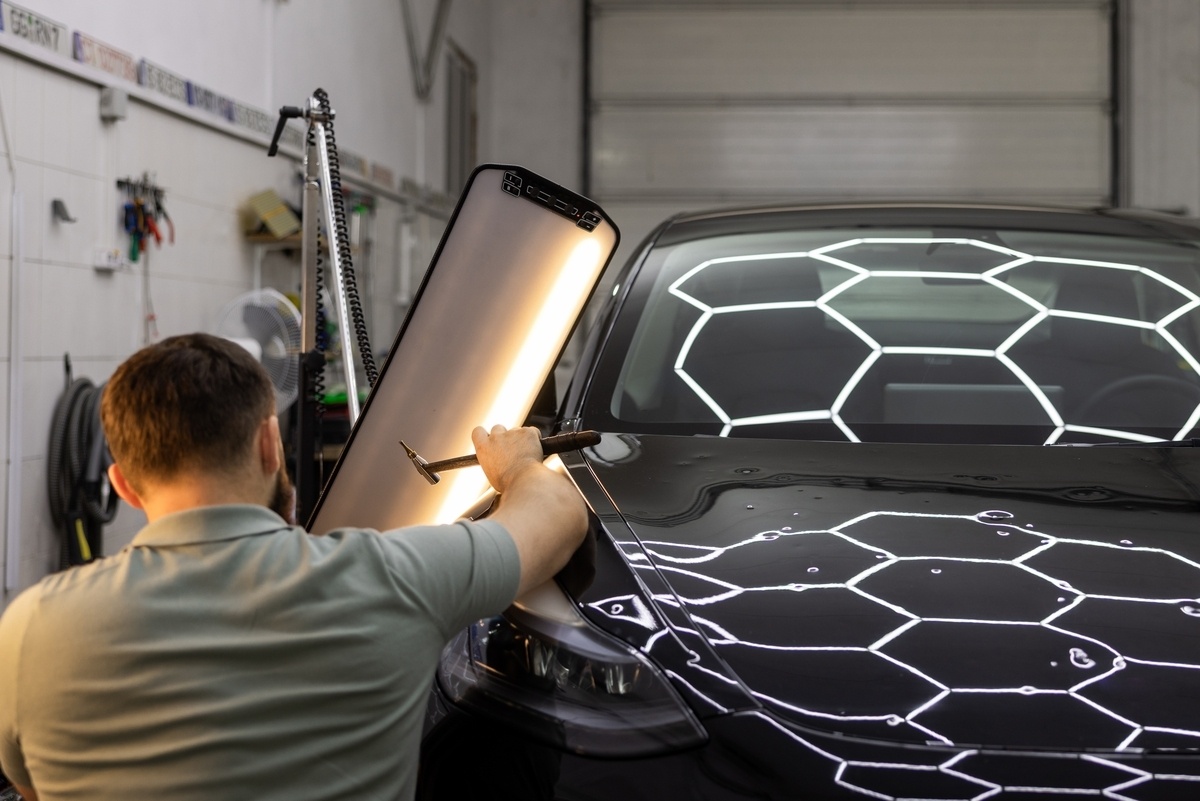
- Reflective light boards that turn dents into visible distortions
- Hand checks across each panel to feel for low spots
- Paint thickness gauges to see whether the factory finish is still bonded
- Close glass inspection for chips and stress lines
- Underside checks of panels to confirm whether tools can reach the dent
The findings are recorded panel by panel. A typical record lists the dent count, the size range, and whether paint is cracked. It also notes whether each panel can be repaired or must be replaced.
These notes feed into the estimate. According to the New York State DMV, a repair shop must give you a written estimate of parts and labor when you ask. It cannot charge more than that estimate without your permission.
A detailed inspection record makes it easier to see what the estimate covers. It also shows what a later change would involve.
4. Paintless Dent Repair Versus Traditional Panel Repair
Two main approaches are used in auto body shop hail damage repair. The choice depends on what the metal and paint look like after impact, not on a shop’s preference.
Dents suited to paintless methods
Paintless dent repair (PDR) is usually considered when:
- The paint is intact with no cracking or flaking
- The metal is shallowly dented and not creased or stretched
- The back of the panel is accessible with specialty tools
- The dents are not sitting on a sharp body line or panel edge
PDR uses metal rods and body tools to massage the dent out from behind the panel. No filler, primer, or paint is needed, which preserves the factory finish.
Dents that need conventional repair
Traditional panel repair is typically required when:
- Paint has cracked or separated from the metal
- Dents are deep, sharp, or have stretched the metal
- The damage sits on an edge or body line that cannot be released cleanly
- The panel is double-layered or braced from behind
- The panel is aluminum, which is less forgiving than steel
Conventional repair involves pulling or hammering the dent, then filling, sanding, priming, and refinishing as needed. It takes longer than PDR. It also corrects damage that tools alone cannot reach.
Many auto body shop hail damage jobs combine both methods. A roof may be repaired with PDR while a heavily dented hood is refinished.
5. The Dent Repair Process From Start to Finish
Although every vehicle differs, hail repairs generally follow the same sequence.
Cleaning and light mapping
The vehicle is washed so dirt does not hide small dents. Technicians then mark each dent with a removable marker or tab. This creates a map of the work and a dent count for each panel.
Access and tool selection
Technicians remove interior trim, headliners, or lamps where needed to reach the back of the panel. Tool length and tip shape are chosen to match each dent’s size and location.
Dent release and metal finishing
Pressure is applied in small, controlled steps from the center outward. The goal is to bring the metal back to its original contour without stretching it further. Light boards are used repeatedly to check progress.
Refinishing panels that need paint
Panels with cracked paint or deep creases are sanded, primed, color matched, sprayed, and clear coated. Nearby areas may be blended so the repaired panel does not stand out. The matching process is covered in how an auto body shop matches paint after a collision repair.
Final inspection under light
The finished panels are checked from multiple angles under reflective lighting. Any remaining low spots are marked and corrected before the vehicle is released.
Timelines for auto body shop hail damage repair vary with the number of dents and the methods involved. As general ranges:
- Light damage repaired with PDR alone often takes a few days
- A mix of PDR and refinished panels commonly takes about a week
- Heavy damage that includes glass, trim, and paint work can take longer
Parts availability, insurer approval, and a surge of claims after a major storm can stretch any of these ranges.
6. Paint, Primer, and Color Matching on Hail-Damaged Panels
Repainting is not automatic in auto body shop hail damage repair. Refinishing is limited to panels where the original finish has failed or where a dent cannot be released without breaking the paint.
When paint is required, several factors influence how well the result blends:
- The age and sun exposure of the surrounding paint
- Whether the color is solid, metallic, or pearl
- Whether adjacent panels need to be blended for a smooth transition
- The quality of surface preparation and clear coat application
The paint code is only a starting point, because years of weathering change how a color looks. The same matching principles apply whenever a refinished hail panel sits next to an original one.
Cold weather also affects paint. Paint becomes less flexible in low temperatures. That is one reason a technician may avoid PDR on questionable paint during winter.
7. Windshield Damage and Sensor Recalibration After Hail
Glass work is a routine part of auto body shop hail damage repair, because hail can chip or crack windshields. A small chip can sometimes be filled with resin. A long crack, a damaged edge, or a shattered panel requires replacement.
Many newer vehicles carry cameras and sensors close to the windshield. According to the National Highway Traffic Safety Administration, driver assistance technologies are a core part of modern vehicle safety. After a glass replacement, those systems often need to be recalibrated so they read the road correctly.
Before approving glass work, it helps to confirm:
- Whether the vehicle uses camera-based lane or braking systems
- Whether recalibration is included with the glass repair
- How the finished calibration will be verified
- Whether a rain sensor or heating element needs to be transferred to the new glass
A windshield that sits slightly differently can change what a camera sees. That is why calibration is treated as part of the repair, not an optional extra.
8. Insurance Claims, Deductibles, and Supplements
Hail damage is typically handled under the comprehensive portion of an auto insurance policy. Liability-only coverage generally does not pay for it. Reviewing the deductible matters, since a small repair may cost less than the deductible.
A typical claim follows these steps:
- Photograph the vehicle before it is moved or washed
- Contact the insurer to open a comprehensive claim
- Obtain a written estimate from a repair shop
- Allow the insurer to review the estimate or inspect the vehicle
- Authorize repairs once the estimate is approved
Auto body shop hail damage claims often involve supplements. An adjuster may work from an exterior look, and further damage can appear once panels are inspected up close or trim is removed. A supplement documents that additional damage with photographs so the insurer can review it.
According to the Federal Trade Commission, a written estimate should list the condition to be repaired, the parts needed, and the anticipated labor charge. Use that list as a starting point when comparing auto body shop hail damage estimates. Useful questions include:
- Which panels will use PDR and which will be refinished?
- Is glass replacement or sensor recalibration included?
- How will extra damage found during repair be documented and approved?
- What warranty applies to the dent repair and the paint?
9. Frequently Asked Questions
No. When the paint is intact and the dents are shallow, paintless dent repair can restore the panel without any paint work. Repainting is needed only when the finish has cracked, chipped, or separated from the metal.
Usually yes, unless the glass is broken or a panel is bent into a moving part. Chipped paint exposes bare metal, which can begin to rust, so long delays are not recommended.
Unrepaired hail damage lowers a vehicle’s assessed value at sale or trade-in. Documented repairs completed at a licensed auto body shop in Brooklyn NY help show that the car was restored properly.
It typically covers dents, glass, and paint damage caused by hail, subject to the deductible and policy terms. Reading the policy or asking the insurer is the only way to confirm the exact coverage.
This is common with hail claims. The shop can submit a supplemental estimate with photographs of the additional damage found once panels are inspected up close.
There is no fixed number. Dent depth, paint condition, and access from behind decide it. A heavy dent count can still be repaired with PDR when the metal is not creased. A few deep dents may need conventional repair.
10. Weighing the Repair Decision
Hail damage rarely shows its full extent right away. Dents are the visible part. Paint stress, glass condition, and sensor alignment can also change what a complete repair requires.
Comparing estimates is easier when each one lists the same items: dent count by panel, the repair method for each, paint and glass work, and any recalibration. Differences between estimates often come from different assumptions about those items. They are not always different prices for the same work.
Knowing how auto body shop hail damage repair works also helps with timing. Rust and glass cracks tend to get worse with time. A clear inspection record is useful even if the repair is scheduled later.
💡 Key Takeaways
- Hail spreads many small impacts across horizontal panels instead of one concentrated hit
- Inspection under reflective light reveals dents that daylight hides
- Paintless dent repair works when paint is intact and the back of the panel is reachable
- Cracked paint, deep creases, and panel edges usually call for conventional repair
- Refinished panels need careful color matching and sometimes blending into neighbors
- Windshield replacement can require sensor recalibration on newer vehicles
- Comprehensive coverage typically handles hail, and supplements document extra damage
- Written, itemized estimates make it easier to compare repairs and approve changes
NOT SURE WHAT KIND OF HAIL DAMAGE YOUR CAR HAS?
Auto body shop hail damage repair can mean paintless work, panel repair, or a mix of both. The right plan depends on how each panel looks up close. If you would like to sort out which dents can be fixed without paint, you can contact us.