

Table of Contents
- 1. Why Paint Matching Is More Complex Than It Looks
- 2. What Auto Body Shop Paint Matching Actually Involves
- 3. How Paint Codes Work and Why They Are Only the Starting Point
- 4. The Role of Spectrophotometers in Color Matching
- 5. How Paint Is Mixed and Applied for a Seamless Result
- 6. Why Blending Is Often Required Beyond the Repaired Panel
- 7. Factors That Make Paint Matching More Challenging
- 8. Questions to Ask Before Approving Paint Work
- 9. Frequently Asked Questions
- 10. What a Good Match Actually Means
When a vehicle comes into an auto body shop after a collision, one of the most demanding parts of the repair is not the bodywork. It is the paint.
Auto body shop paint matching is the process of recreating the exact color, finish, and texture of a vehicle’s original paint on repaired or replaced panels. The goal is to make the repair invisible.
This guide explains how the process works, why it goes far beyond selecting a color code, and what drivers should know before approving any paint work.
1. Why Paint Matching Is More Complex Than It Looks
Most drivers assume paint color is fixed by the manufacturer. They expect any shop to look up the code and apply the same paint. Getting a result that is invisible in all lighting conditions is much harder than that.
Several factors create the challenge:
- Vehicle paint shifts in tone and sheen as it ages and weathers
- Factory paint is applied under controlled conditions a body shop cannot fully replicate
- Two vehicles with the same color code and model year may have slightly different paint due to batch variation
- Metallic and pearl finishes contain particles whose orientation during spraying affects the final look
- The same color appears different under fluorescent shop lighting versus direct sunlight
These variables mean auto body shop paint matching requires measurement, formula adjustment, test panels, and skilled application. A code lookup alone will not produce a reliable result.
2. What Auto Body Shop Paint Matching Actually Involves
Auto body shop paint matching covers the full sequence from identifying the original color specification to the final clear coat that protects the repair.
The key steps are:
- Identifying the paint code — locating the manufacturer’s color code on the vehicle as the starting reference
- Measuring the actual paint — using electronic equipment to capture the precise color values of the existing finish, including any shift from the factory spec
- Mixing the formula — creating the repair paint based on measured values, not the original code alone
- Applying test panels — spraying a sample and comparing it to the vehicle under multiple light sources before the full repair
- Applying the color coat — painting the repaired panel with the adjusted formula
- Blending into adjacent panels — extending new paint into neighboring panels to create a gradual, invisible transition
- Applying clear coat — sealing the color with a protective layer that matches the surrounding sheen
Each step matters. Rushing any of them raises the risk of a visible color difference the driver will notice in every parking lot.
For a clear picture of how this fits into a complete collision repair, the car painting service page covers the equipment and approach used at a qualified facility.
3. How Paint Codes Work and Why They Are Only the Starting Point
Every vehicle from a major manufacturer carries a paint code. It identifies the color used during production. The code is typically found on a placard in the door jamb, under the hood, or in the trunk.
The paint code tells the body shop which color family the paint belongs to. It is the starting point for auto body shop paint matching, not the endpoint.
Paint codes correspond to a base formula. They do not reflect the exact color of any individual vehicle.
Paint is applied at the factory in batches. Vehicles age at different rates depending on climate, sun exposure, and care. The actual color on the car almost always differs from the base formula to some degree.
A shop that applies the base formula without measuring the existing paint will produce paint that matches the code but not the car. The gap may be subtle or obvious. Either way, it will show under direct sunlight.
4. The Role of Spectrophotometers in Color Matching
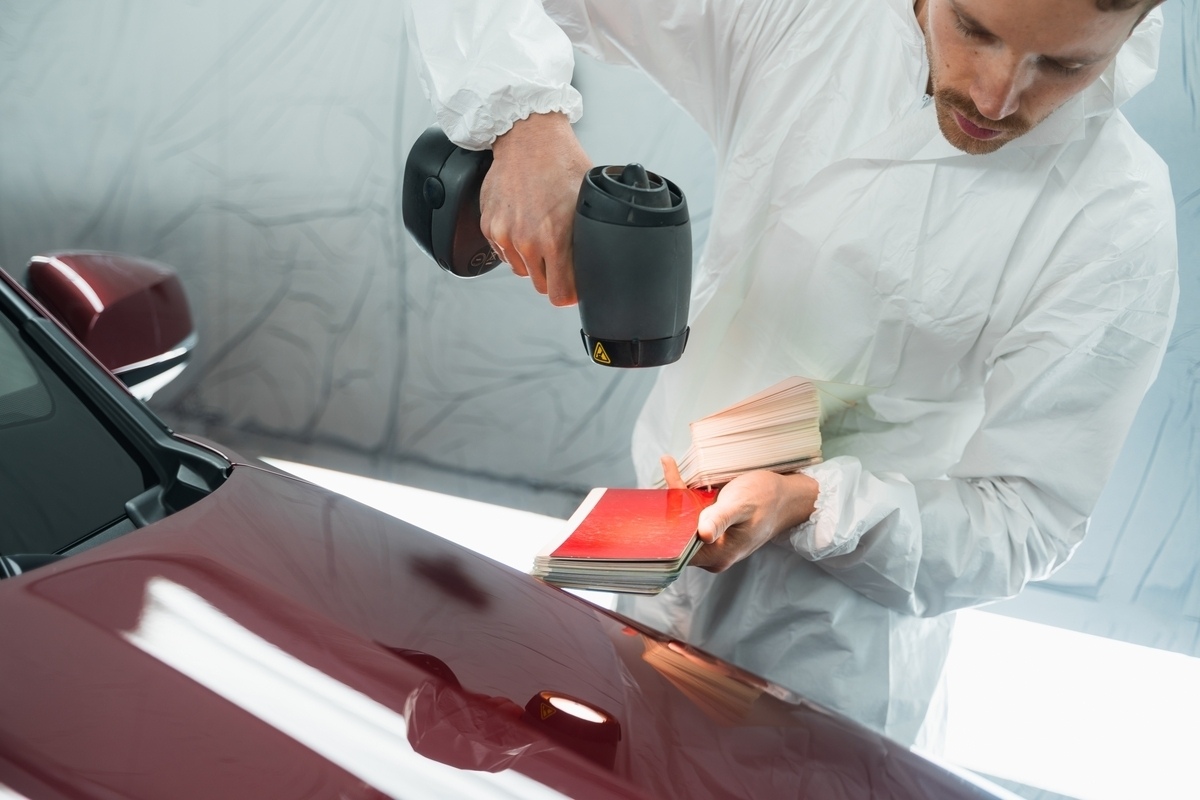
A spectrophotometer is the measuring device that makes precise auto body shop paint matching possible.
It shines light onto the existing paint surface. It then measures how that light is absorbed and reflected across the color spectrum. The result is a numerical profile of the paint.
That profile captures:
- The hue, value, and saturation of the base color
- The behavior of metallic flakes or pearl particles
- How the color shifts when viewed from different angles
This data feeds into mixing software. The software compares it against thousands of stored variants. It identifies the formula closest to the measured values.
The shop mixes paint to that formula, not the original manufacturer code.
According to the Federal Trade Commission Auto Repair Basics guide, consumers have the right to know which type of parts and materials are used in their repair. This principle applies to paint. Drivers can ask whether the shop measured the existing color before mixing, or whether they relied on the code alone.
5. How Paint Is Mixed and Applied for a Seamless Result
Once the formula is set, the paint is mixed from base toners in specific ratios. Modern systems use water-based or solvent-based formulas depending on the shop’s equipment and the vehicle’s original paint type.
The mixing requires accuracy. Small ratio errors shift the color enough to be visible. Shops use calibrated scales and maintained equipment to keep variation within tolerance.
Application technique matters just as much. The way paint is sprayed affects the final look. This is especially true for metallic and pearl finishes where reflective particles align during spraying.
Key application factors include:
- Gun distance and angle — controls particle orientation and film thickness
- Spray pattern overlap — determines how evenly color distributes across the panel
- Number of coats — builds color depth gradually to match the existing finish
- Flash time between coats — lets solvents evaporate correctly before the next layer
- Shop conditions — temperature and humidity affect how paint flows and dries
6. Why Blending Is Often Required Beyond the Repaired Panel
Even with an accurate formula and skilled application, painting only the repaired panel often leaves a visible edge. This is where blending comes in.
Blending extends the new paint into adjacent panels. It creates a gradual transition from the repair into the undamaged finish. The goal is to make the boundary invisible.
Auto body shop paint matching that includes blending produces better results than single-panel repair in most real-world situations.
Blending is most often needed when:
- The vehicle has age-related color shift that makes an exact single-panel match impossible
- The repaired panel sits next to a large visible surface like a door or fender
- The paint contains metallic or pearl elements where old-to-new boundaries show more clearly
- The repair covers only part of a panel and the adjacent undamaged area looks noticeably different
Blending adds cost and time. It is often the step that determines whether the final result is invisible or leaves a line.
7. Factors That Make Paint Matching More Challenging
Some vehicles and situations create greater matching challenges. Understanding these helps drivers set realistic expectations.
Color type
Solid colors with no metallic content are the easiest to match. Metallic colors contain reflective particles that change appearance with viewing angle. Pearl finishes add interference layers that shift color with the light source. Both require more measurement and more careful application.
Vehicle age and weathering
The longer a vehicle has been exposed to sun and weather, the more the paint has shifted from the factory specification. A ten-year-old car in a coastal climate will have paint that has drifted significantly from the original code.
Panel location
Horizontal surfaces like hoods and roofs get more direct sun. They fade faster than vertical panels. A repair on a horizontal panel next to less-faded vertical panels creates a matching challenge that blending alone may not fully resolve.
Prior paint work
A vehicle repainted previously may have multiple paint generations on different panels. Each has its own color variation. The shop needs to identify which generation the new repair must match.
According to the NY DMV Know Your Rights in Auto Repair, registered shops in New York must disclose the type of materials used in a repair. Drivers should ask the same of paint work. Ask whether a spectrophotometer was used, what system is being applied, and what warranty covers the paint job.
8. Questions to Ask Before Approving Paint Work
Before signing off on any paint repair after a collision, ask these specific questions:
- Was the existing paint measured with a spectrophotometer before the formula was mixed?
- Is the shop adjusting based on measured values, or relying on the manufacturer code alone?
- Will blending into adjacent panels be included if needed?
- What paint system is being used, and is it compatible with the vehicle’s original finish?
- How many coats will be applied, and what is the curing process?
- What warranty covers the paint work, and what does it include?
- Will a test panel be checked under multiple light sources before the full repair?
A shop that performed proper auto body shop paint matching will answer all of these clearly and without hesitation.
According to the NY DMV Repair and Body Shops guidelines, body shops in New York are regulated by the DMV and must meet state repair standards. Choosing a registered shop gives drivers access to the DMV’s formal complaint process if the work falls short.
For a broader view of how paint quality connects to what buyers and appraisers see at resale, the auto body repair resale value blog covers exactly that.
9. Frequently Asked Questions
Lighting changes how color is perceived. Fluorescent shop light, natural daylight, and direct sun each reveal different color characteristics. This is especially true in metallic and pearl finishes. A professional shop evaluates the result under multiple light sources before the repair is finalized.
Most shops can attempt it. Quality depends on the equipment, the technician’s skill, and the process. A shop that measures the existing paint and tests the formula before application produces more reliable results than one working from the code alone.
Most automotive paints are dry to the touch within hours. Full curing takes several weeks. During that period, avoid automated car washes, waxing, and prolonged moisture exposure. Ask the shop for specific care instructions based on the system they used.
Not necessarily. New paint ages differently from paint that has already weathered. Over time, the two may diverge slightly in color. This is a normal characteristic of paint repair, not a defect. It is one reason blending is often preferred over a strict single-panel repair.
Take photographs in multiple lighting conditions including direct sunlight. Return to the shop and request a formal assessment. Under New York’s Repair Shop Act, you have the right to have concerns addressed before the repair is considered complete. If the shop used proper measurement and blending, a visible mismatch in normal light may indicate a process error.
Yes. A visible paint repair reduces buyer confidence and lowers appraisal value. Buyers and dealers inspect paint carefully and apply a larger discount to vehicles with visible repair evidence. A properly executed paint repair that is invisible to the eye has minimal effect on value. For more on how repair quality connects to what buyers look for, the auto body shop in Brooklyn NY page covers what a complete professional repair involves.
10. What a Good Match Actually Means
Auto body shop paint matching succeeds when the repair is invisible in normal viewing conditions. The color, finish, and texture of the new paint look the same as the surrounding panels. This holds from multiple angles and under multiple light sources.
Getting there takes more than a code lookup.
It takes measurement. It takes a formula adjusted to the actual vehicle. It takes proper application and often blending into adjacent panels. It takes testing before the final coat.
Drivers who know what the process should involve can evaluate estimates more clearly. They can ask better questions. They can recognize a repair done correctly from one that was not.
That knowledge is the most practical tool available before approving any paint work after a collision.
💡 Key Takeaways
- Auto body shop paint matching requires measuring the existing paint with a spectrophotometer, not just referencing the manufacturer’s color code
- Paint codes are a starting point. The actual color on a vehicle shifts from the factory spec through weathering, sun exposure, and batch variation
- Metallic and pearl finishes are harder to match than solid colors because reflective particles change appearance with angle and lighting
- Blending into adjacent panels is often required to eliminate a visible edge between repaired and undamaged paint
- Application technique, gun angle, coat count, flash time, and shop conditions, directly affects the final result
- New York’s Repair Shop Act gives drivers the right to know what materials are used and to have concerns addressed before a repair is considered complete
- A visible paint mismatch at resale reduces buyer confidence and lowers appraisal value
- A proper auto body shop paint matching result is invisible to the eye and has minimal impact on the vehicle’s value
HAVE QUESTIONS ABOUT PAINT MATCHING AFTER A COLLISION REPAIR?
Understanding how auto body shop paint matching works helps drivers ask better questions and evaluate the results they receive. If you have questions about the painting process or what a complete collision repair should include, our team is available to help.