

Table of Contents
- 1. Why Suspension Damage After a Collision Gets Missed
- 2. What Auto Body Shop Suspension Repair Actually Covers
- 3. The Suspension Components Most Affected by Collision Impact
- 4. How a Body Shop Diagnoses Suspension Damage
- 5. The Repair Process From Assessment to Road Test
- 6. Why Suspension Repair Belongs at an Auto Body Shop
- 7. What Happens If Collision Suspension Damage Goes Unaddressed
- 8. Questions to Ask Before Authorizing Suspension Repairs
- 9. Frequently Asked Questions
- 10. Knowing What to Expect
When a vehicle is in a collision, most drivers focus on the visible damage. Crumpled panels, broken lights, and scratched paint are easy to see. What happens underneath the vehicle is harder to notice. Auto body shop suspension repair addresses the damage a collision does to the systems that control how a vehicle handles, rides, and stays in contact with the road.
This guide covers what suspension damage looks like after a collision, how a qualified shop assesses and fixes it, and what drivers should know before saying yes to repair work.
1. Why Suspension Damage After a Collision Gets Missed
The suspension system sits below the body panels. It is not visible during a standard walkthrough from outside the vehicle.
A car that looks fine after a low-speed impact may have bent control arms or damaged ball joints. These are invisible until the vehicle is lifted and examined by a technician.
Several factors explain why suspension damage gets overlooked:
- Drivers check the outside of the car and focus on panel damage and paint
- Symptoms like pulling or vibration develop slowly and are easy to dismiss
- Some shops address cosmetic damage without lifting the vehicle for a full check
- Drivers assume the car is fine if it still drives
Auto body shop suspension repair starts with a proper lift inspection. That step is what makes the difference between finding the damage and missing it entirely.
2. What Auto Body Shop Suspension Repair Actually Covers
Auto body shop suspension repair covers every component in the suspension system that a collision can damage.
The suspension connects the vehicle to its wheels. It manages how road forces are absorbed and passed through the vehicle. A collision can damage these components directly through impact or indirectly through force traveling along the frame and subframe.
Common components addressed in auto body shop suspension repair include:
- Shock absorbers and struts — absorb road impact and control body movement
- Springs — support the vehicle’s weight and maintain ride height
- Control arms — connect the suspension to the frame and guide wheel movement
- Ball joints — allow the wheel and suspension to move through their full range
- Tie rods — connect the steering rack to the wheels
- Sway bar links and bushings — reduce body roll during cornering
- Subframe components — provide the structural mounting points for everything above
Damage to any one of these affects how the vehicle drives and how safely it responds in an emergency.
For a clear picture of what a complete repair involves beyond just suspension, the body work and car repair service page covers the full scope of post-collision work at a professional level.
3. The Suspension Components Most Affected by Collision Impact
Not all suspension components are equally at risk. The impact type and direction determine which parts absorb the most stress.
Front-end collisions
A direct front-end impact sends force along the front axle and into the steering components. Control arms, tie rods, and strut assemblies on the impacted side take the most direct hit. The subframe may also shift or crack, which affects multiple mounting points at once.
Rear-end collisions
Rear impacts affect the rear suspension first. Rear control arms, trailing arms, and the rear subframe are the most common targets. If the vehicle is pushed forward into a secondary contact, that force can also reach the front suspension.
Side impacts
Side impacts bend or fracture control arms and ball joints on the struck side. The sway bar and its mounts are also commonly damaged. A direct hit to the wheel can push the entire suspension assembly out of position.
Low-speed impacts
Low-speed collisions cause more hidden suspension damage than most drivers expect. The body panels take the visible hit. The components underneath absorb force that may bend or crack them without producing any obvious symptoms right away.
According to the National Highway Traffic Safety Administration, suspension components are built to specific tolerances that affect both handling and occupant protection. A part that has been deformed past those tolerances may still function but no longer performs as designed.
4. How a Body Shop Diagnoses Suspension Damage
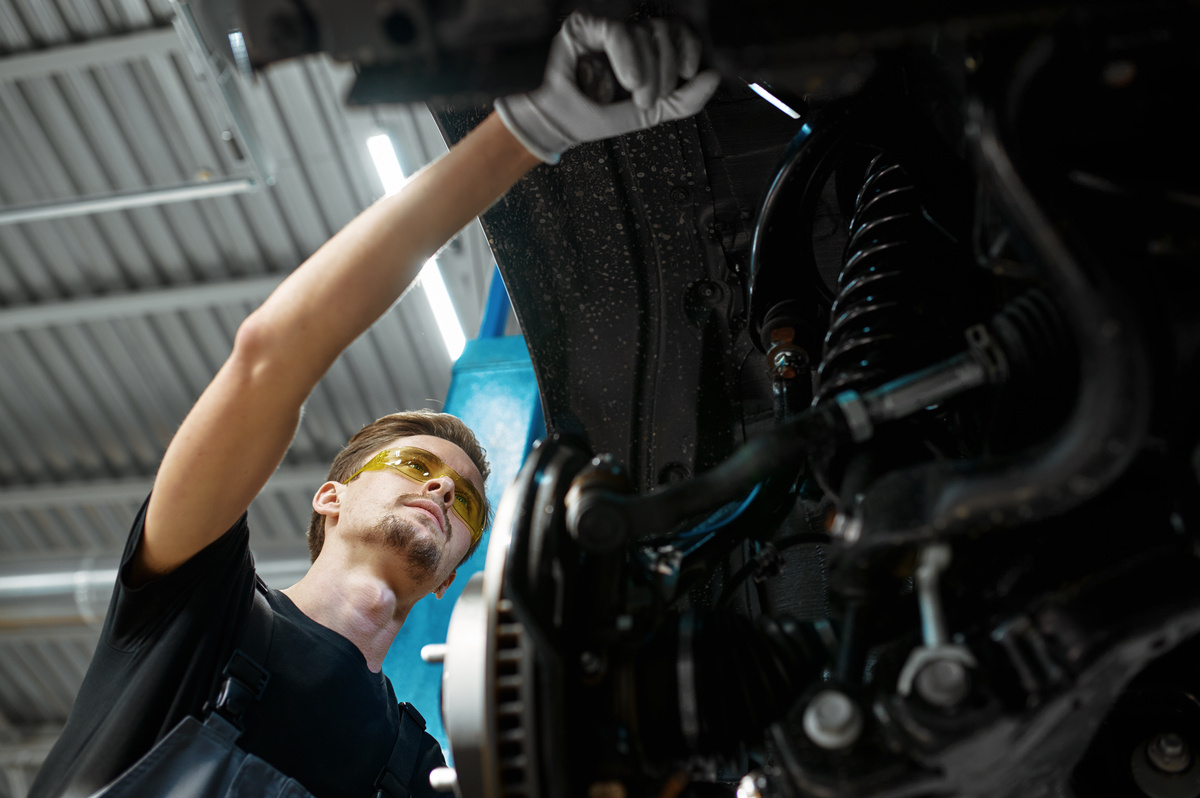
Diagnosing suspension damage after a collision requires lifting the vehicle. A road test helps, but it cannot replace a hands-on inspection with the wheels off the ground.
A qualified shop follows these diagnostic steps:
- Visual inspection on the lift — checking for bent, cracked, or displaced components across the full assembly
- Physical component checks — feeling for looseness or play in ball joints, tie rods, and bushings
- Computerized alignment measurement — comparing actual wheel angles to factory specs
- Subframe inspection — looking for cracks, deformation, or shifting at mounting points
- Road test — evaluating handling, steering response, noise, and vibration under real driving conditions
According to the NY DMV Know Your Rights in Auto Repair, registered repair shops in New York must provide a written estimate detailing each repair item and its cost before starting work. A proper diagnosis should result in a clearly itemized estimate. Each damaged component and the required repair or replacement should be listed separately.
5. The Repair Process From Assessment to Road Test
Auto body shop suspension repair follows a consistent sequence once the diagnosis is done.
Component removal and inspection
Damaged parts come off the vehicle first. Some components look intact during a visual check but reveal deformation or cracking once they are off the car and examined up close.
Parts selection
Replacement parts are chosen based on the vehicle’s make, model, and year. OEM parts match the factory specs for fit and performance. Aftermarket quality varies significantly. The parts choice affects how well the repair holds up over time.
Installation to spec
New components go in at manufacturer torque specifications. Correct torque matters. Under-torqued fasteners loosen under stress. Over-torqued fasteners crack or strip.
Computerized alignment
After installation, a four-wheel alignment confirms that the new components sit at the correct angles. This step is not optional. It verifies that the auto body shop suspension repair has actually corrected the vehicle’s geometry, not just replaced the parts.
Road test
A final road test confirms correct handling, no abnormal sounds, and proper steering response. Any problem found during the road test sends the vehicle back for further assessment before release.
6. Why Suspension Repair Belongs at an Auto Body Shop
Suspension repair after a collision is different from routine maintenance at a general mechanic. A collision creates force that moves through multiple connected systems at once.
Suspension damage from a crash almost always comes alongside body or structural damage. An auto body shop that handles the full collision repair assesses the suspension in context. It does not look at one system in isolation while ignoring what happened to the others.
Specific reasons auto body shop suspension repair is the right choice after a crash:
- Body shops have alignment equipment built for post-collision correction, not just routine adjustments
- They assess suspension components alongside frame and subframe condition
- They coordinate all collision-related repairs in one process
- They document suspension damage for insurance purposes with itemized findings
According to the NY DMV Vehicle Safety Inspection Program, New York State safety inspections include steering and suspension components. A vehicle with unrepaired collision-related suspension damage may fail inspection. Getting auto body shop suspension repair done as part of the overall collision repair keeps the vehicle compliant with state safety requirements.
7. What Happens If Collision Suspension Damage Goes Unaddressed
Suspension damage from a collision does not stay the same. It gets worse.
The misalignment creates ongoing stress on connected components. That stress accelerates wear on parts that were not directly hit.
Consequences of leaving collision suspension damage unrepaired:
- Accelerated and uneven tire wear from incorrect wheel angles
- Faster deterioration of ball joints, bushings, and control arms under abnormal load
- Unpredictable handling, especially during emergency maneuvers
- Corrosion at cracked component surfaces over time
- Failing the annual New York State safety inspection
The cost of fixing the secondary damage caused by ignoring the original problem almost always exceeds the cost of the original repair itself.
For a parallel look at how unaddressed structural damage compounds over time, the post on unrepaired frame damage covers the same pattern for frame and chassis components.
8. Questions to Ask Before Authorizing Suspension Repairs
Before approving any suspension repair after a collision, ask these specific questions:
- Was the vehicle lifted and inspected with the wheels off the ground before this estimate?
- Which components are being replaced and which are staying?
- Are replacement parts OEM or aftermarket, and what is the warranty on each?
- Does the repair include a four-wheel computerized alignment?
- Will a road test be done before the vehicle is returned?
- How does the suspension damage relate to any frame or subframe damage found?
- Is there a labor warranty on the suspension work?
A qualified shop will answer all of these clearly. If a shop cannot, that is worth noting before signing off on the work.
For more on what a complete collision assessment at a professional auto body shop in Brooklyn NY should include, that resource walks through the full evaluation process.
9. Frequently Asked Questions
A suspension that feels fine right after a collision may develop problems as damaged components wear down under driving stress. If the collision was significant, get a professional assessment before driving the car regularly. Many symptoms show up later and trace back to damage that was already present at the time of impact.
Common signs include pulling to one side, a steering wheel that sits off-center on a straight road, unusual noises over bumps, a rougher ride than before the crash, and uneven tire wear developing in the weeks after. Any of these after a collision warrants a professional inspection.
Collision coverage usually includes suspension damage caused by an accident. The specific terms depend on the policy. A written assessment from a qualified shop that documents the damage and connects it to the collision supports the claim process.
No. Many suspension components require the vehicle to be lifted for a proper look. A visual check from outside the car cannot reliably detect bent control arms, cracked ball joints, or damaged tie rods.
Alignment adjusts wheel angles to match factory specifications. Suspension repair fixes the physical components, springs, struts, control arms, ball joints, tie rods, that are damaged or worn. Alignment is done after suspension repair to confirm the new components are positioned correctly. Alignment alone cannot fix component damage.
A repair involving one or two components typically takes one to two days. More extensive damage involving multiple components or subframe work takes longer. Additional time may be needed if hidden damage is found during disassembly.
10. Knowing What to Expect
Auto body shop suspension repair after a collision is a technical process. It requires proper equipment, trained technicians, and a systematic approach from the first lift inspection through the final road test.
Knowing what the process involves helps drivers ask the right questions and evaluate the estimates they receive. The goal is not to challenge the shop. It is to make sure the repair addresses the actual damage rather than just the visible parts.
A suspension damaged in a collision does not recover on its own. The handling changes. Component wear speeds up. The margin for safe emergency response shrinks. Getting auto body shop suspension repair done correctly from the start is the most practical choice after any collision that affected the underside of the vehicle.
💡 Key Takeaways
- Auto body shop suspension repair covers shocks, struts, springs, control arms, ball joints, tie rods, and subframe components damaged by collision impact
- Suspension damage after a crash is often invisible from outside the vehicle and requires a lift inspection to find
- Front, rear, and side impacts each damage different components — low-speed collisions cause more hidden suspension damage than most drivers expect
- Proper diagnosis requires lifting the vehicle, physically checking each part, and running a computerized alignment measurement
- Getting auto body shop suspension repair done at a collision shop is the right choice after a crash because it assesses the suspension alongside frame condition in one coordinated process
- New York State safety inspections include suspension components — unrepaired collision damage may cause a vehicle to fail
- Ignoring suspension damage after a collision accelerates tire wear and component failure, and makes handling less predictable over time
- Before authorizing repairs, confirm the vehicle was lifted for inspection, ask about OEM versus aftermarket parts, and verify that alignment and a road test are included
HAVE QUESTIONS ABOUT SUSPENSION REPAIR AFTER A COLLISION?
Understanding what auto body shop suspension repair involves helps drivers make better decisions after an accident. If you have questions about the assessment process or what a complete collision repair includes, our team is available to help.
References
- National Highway Traffic Safety Administration — Vehicle Safety: https://www.nhtsa.gov/vehicle-safety
- NY DMV — Know Your Rights in Auto Repair: https://dmv.ny.gov/know-your-rights-in-auto-repair
- NY DMV — Vehicle Safety and Emissions Inspection Program: https://dmv.ny.gov/new-york-state-vehicle-safetyemissions-inspection-program